
The big issue today is rather how do we manage the social media we have in order to use them as well as the resources we spend effectively and efficiently.
Coming back to the goal of social media for companies is to be able to interact and engage with customers. Breaking the traditional one-way communication, social media help companies attract customers to open discussion, testimonials, or help gather ideas for the company in a two-way communication model. Through social media, company can talk to customers and customers can talk to another customers. After investing some capital on maintaining a good social media and contents and hiring some staff to take care of company's Facebook, Twitter, and blogs for example, now the challenge is how do we manage the conversation or cases opened in these medias? Who? What conversation? and How should company respond to these posts/tweets?
 Social CRM, which is basically an additional features within CRM softwares, helps solve this issue by providing features that allow staff or users in general to not only respond to customers through traditional phone lines or email, but also social medias: Facebook Twitter, and other forms of social media platforms. Social CRM application recognizes new posts/tweets from customers to company's page and usually notify and assign a representative to the conversation. Besides this feature, some applications allow representative to look for the most popular mention or topics that customer talk about regarding their products and respond to their tweets based on how many followers the customer has; the more followers, the more influential this customer is. Some other applications may allow users to respond to customer's posts according to their satisfaction level; if customers are not very happy and satisfied about current service, they will get served first.
Through these capabilities, customers' conversations in company's social media are answered and responded effectively and efficiently, so customers will not think that company's page is not functional, solely a dead page.
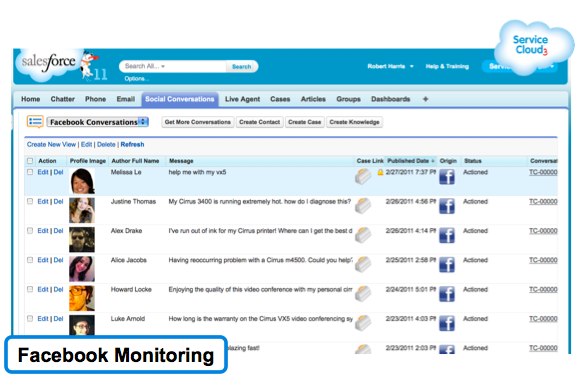 Besides this capability, some applications software also allows users to save customer's information based on their information in the social media. This helps company expand their customer database even more, which means help their marketing effort to grow profit and market base. Other features such as knowledge library/sources within the company or customer blogs, and livechat capability with customers are additional features to social CRM application that help representative respond to customers faster and in a more reliable manner. An example that I found really great is customer posting a question regarding his camera (company's product) on company' Facebook. As soon as the representative got notified, the representative who might not be familiar with the company can open the chat features and include his/her colleagues who knows better about this product to answer the question. Besides this option, representative can also go to the blogs/discussion sites that was created as a knowledge silo containing questions and answers from customers about products. After representative found the answer, he/she can reply to the customer through social media, which might be seen by other people in the social media page and bring a positive image about the company in a big picture.
Some companies today that are leaders in the market are Salesforce.com, Jive, and Lithium. While others such as Oracle and Bazaarvoice are growing and currently classified as challengers within the industry (Gartner Magic Quadrant, 2012).
So what should companies adopt Social CRM?

Another additional benefits is the ability for company to obtain more customer information through social media, analytics, and reports on social media interaction between company and customer.
Although social CRM is a relatively new technology, industry has seen a growing improvement and new competitors entering the product market. This is a sign that Social CRM will still be growing within the near future.
C.A.
Sources:
Salesforce.com
Oracle.com
Jive.com
Gartner Magic Quadrant

No comments:
Post a Comment